Trusted Reference Information
 Edit on GitHub
Sources: 1
What is reference information library?
Reference information libraries support fully integrated computer systems, enabling automated functions, such as identification and decision support, within the context of an environment.
This structured information is prepared prior to a mission, based on a large pool of intelligence and environmental characteristics relevant to a mission outcome.
The reference information library is then used to optimize a platform and its sensors.
A major challenge in generating reference information is ensuring its currency, relevance, and accuracy.
Reference Information update
In general, the process is as follows:
- The vessel leaves port with the reference information describing the expected features in the operational environment
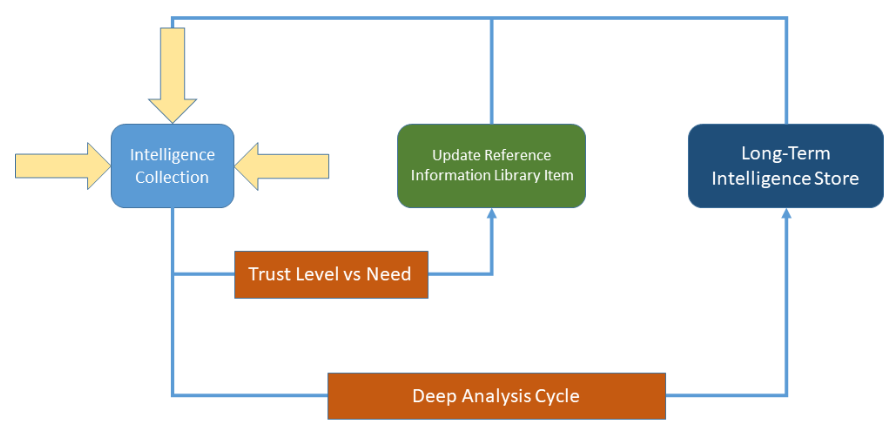
- The vessel measures the environment and produces new information with combat information to refine the reference information (i.e., producing deltas to the apriori information).
- New information is confirmed by communication with other vehicles and headquarters
- The vessel updates its reference information and optimize its combat system to operate in the environment
Dynamic Reference Information
Because of the time and rigour necessary to prepare reference information libraries, these libraries tend to be static and not adaptive to unexpected occurences or outcomes.
Near real-time updates to the entity descriptions held within the reference library would aid in achieving the adaptability required.
Dynamic Reference Information Library is a dynamic library where entity descriptions can be updated during the mission to reflect new intelligence collected either by the platform itself or shared by another platform across the communication network.
One of the key challenges facing the realisation of dynamic reference information is establishing trust in the library updates in near real-time.
Explicit vs implicit knowledge
In a dynamic environment, reference information is available from both implicit and explicit knowledge, and can be used to increase situational awareness.
- In the tactical military domain, the use of reference information by platforms is typically explicit, as it provides a mission or combat system the context fo the environment in which it is operating (i.e., machines are explicitly loaded an explicitly defined library of information)
- Implicit reference information is largely contained within the opertors of the platforms (i.e., humans)
Although the Surf Lifesaving South Australia (SLSSA) assets do not contain mission or combat systems, the explicit and implicit use of reference information can nonetheless be studied through observation of the information exchange, processing and subsequent action.
Reference information exists in the RISE experimentation knowledge in two forms:
- Explicit: TEXAS environment and configuration files
- Implicit: knowledge and experience of SLSSA personnel.
Content of Reference Information Library
Order of battle category:
- Command structure (e.g., leads, lead onsite, patrol captains)
- Force composition (e.g., a patrol has suft life savers, mobile units, inflatable rescue boat)
- Force strength (e.g., numbers of platforms)
- Equipment fit (e.g., a rescue boat has a radio, sonar, GPS unit and first aid kit)
Characteristics and Performance category:
- Physical characteristics of a craft (e.g., colour, length, registration number)
- Typical performance characteristics (e.g., speed, manoeuvrability, operational range)
Geographical intelligence category:
- Maps
- Navigation charts
- Cultural features
- Geographically referenced activities (e.g., regular yacht race)
- Topographic information
Miscellaneous information that describes the environment:
- Weather data
- Communication plans
- Icon and symbology assignments
Focus of DST Group
Investigate information exchange and processing to provide insight into transitioning reference information into a dynamic real-time paradigm.
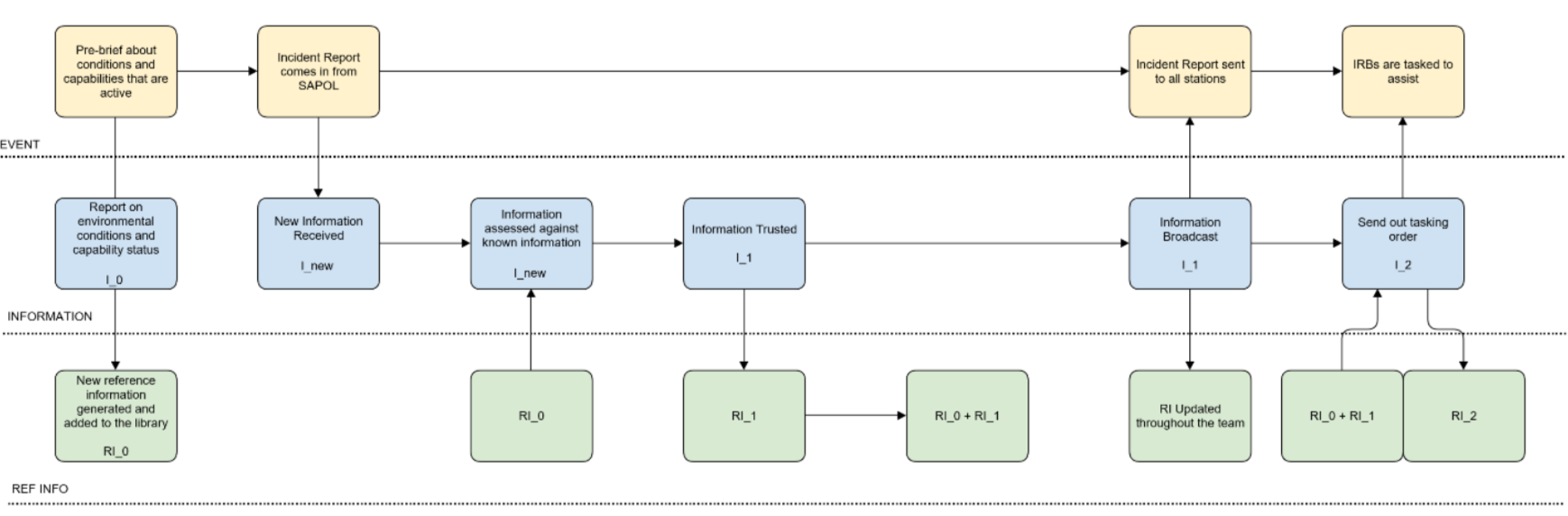
Preliminary results1 suggests that the updates to the reference information are trusted based on comparison to expectations (e.g., expected behaviours or trust ontology).
the concept of reducing decision risk through the sharing of metadata seems key, where the metadata reflects a trustworthiness property or trust-attitude, following assessment by the information receiver.1
The goal of the present research was to test and understand trust in the context of reference information from both the explicit and implicit viewpoint.
Specifically, how trust is coupled with reference information in a real-time context, whereby information updates are assessed and then trusted, realising a potential approach to dynamic reference information.
How is the trust of the reference information library affected as a result of new information, discovered as part of the mission, being added dynamically to that library? Understanding the process of building and maintaining trust in reference information is important, particularly when seeking to move towards a dynamic reference information paradigm.