Blockchain Definitions and Properties
 Edit on GitHub
Definitions
Blockchain and Distributed Ledger
Blockchains are emerging digital technology that combines cryptography, data management, networking, and incentive mechanisms to support the checking, execution, and recording of transactions between parties1.
Distributed Ledger: A distributed ledger is an append-only store of transactions which is distributed across many machines 1
Blockchain: A blockchain is a distributed ledger that is structured into a linked list of blocks. Each block contains an ordered set of transactions. Typical solutions use cryptographic hashes to secure the link from a block to its predecessor.
Blockchain platforms and systems
Blockchain system: A blockchain system consists of: 1
- a blockchain network of machines, also called nodes;
- a blockchain data structure, for the ledger that is replicated across the blockchain network. Nodes that hold a full replica of this ledger are referred to as full nodes;
- a network protocol that defines rights, responsibilities, and means of communication, verification, validation, and consensus across the nodes in the network. This includes ensuring authorization and authentication of new transactions, mechanisms for appending new blocks, incentive mechanisms (if needed), and similar aspects
Public blockchain: A public blockchain is a blockchain system that has the following characteristics 1
- it has an open network where nodes can join and leave as they please without requiring permission from anyone;
- all full nodes in the network can verify each new piece of data added to the data structure, including blocks, transactions, and effects of transactions;
- its protocol includes an incentive mechanism that aims to ensure the correct operation of the blockchain system including that valid transactions are processed and included in the ledger and that invalid transactions are rejected.
Blockchain platform: A blockchain platform is the technology needed to operate a blockchain. This comprises1:
- The blockchain client software for processing nodes
- The local data store for nodes
- Any alternative clients to access the blockchain network
Smart contracts and blockchain-based applications
Smart contract: smart contracts are programs deployed as data in the blockchain ledger and executed in transactions on the blockchain. Smart contracts can hold and transfer digital assets managed by the blockchain and can invoke other smart contracts stored on the blockchain. Smart contract code is deterministic and immutable once deployed 1.
Due to smart contracts, blockchains can be a general computational platform, albeit with severe practical limitations on computational complexity.
Smart Contracts can be thought as self contained pieces of code providing services to the external world, and the blockchain environment can be considered as the gateway by which Smart Contracts provide such services.
Even if the code is permanently sotred as it is, another smart contract enhancing or correcting a previous one can be deployed in the blockchain in order to implement versioning to correct bugs, to refactor, or to add new features to the software code. 4
Blockchain-based applications are applications that make significant use of blockchains 1.
Decentralized applications or dapps are applications designed to provide their main functionality through smart contracts.
Blockchain-oriented Software (BOS) all software working with an implementation of a Blockchain. 3
Smart Contracts vs Microservices
Similarity between smart contracts and microservices 4
- Smart contracts can be thought of as self-contained pieces of code providing services to the external world, where the world can be another smart contract or an external user
- The Web3 library or the blockchain environment can be considered a gateway by which smart contracts provide such services.
- New smart contracts can be deployed to replace the previous ones, allowing for a plug-and-play scheme similarly to microservices.
- Smart contracts can be developed so that it does not hold state, such as by using only view and pure functions, allowing them to achieve the stateless requirements of microservices.
- Some platforms, such as Hyperledger Fabric allows for interaction between smart contracts written in different programming languages, which is similar to the case of micro services.
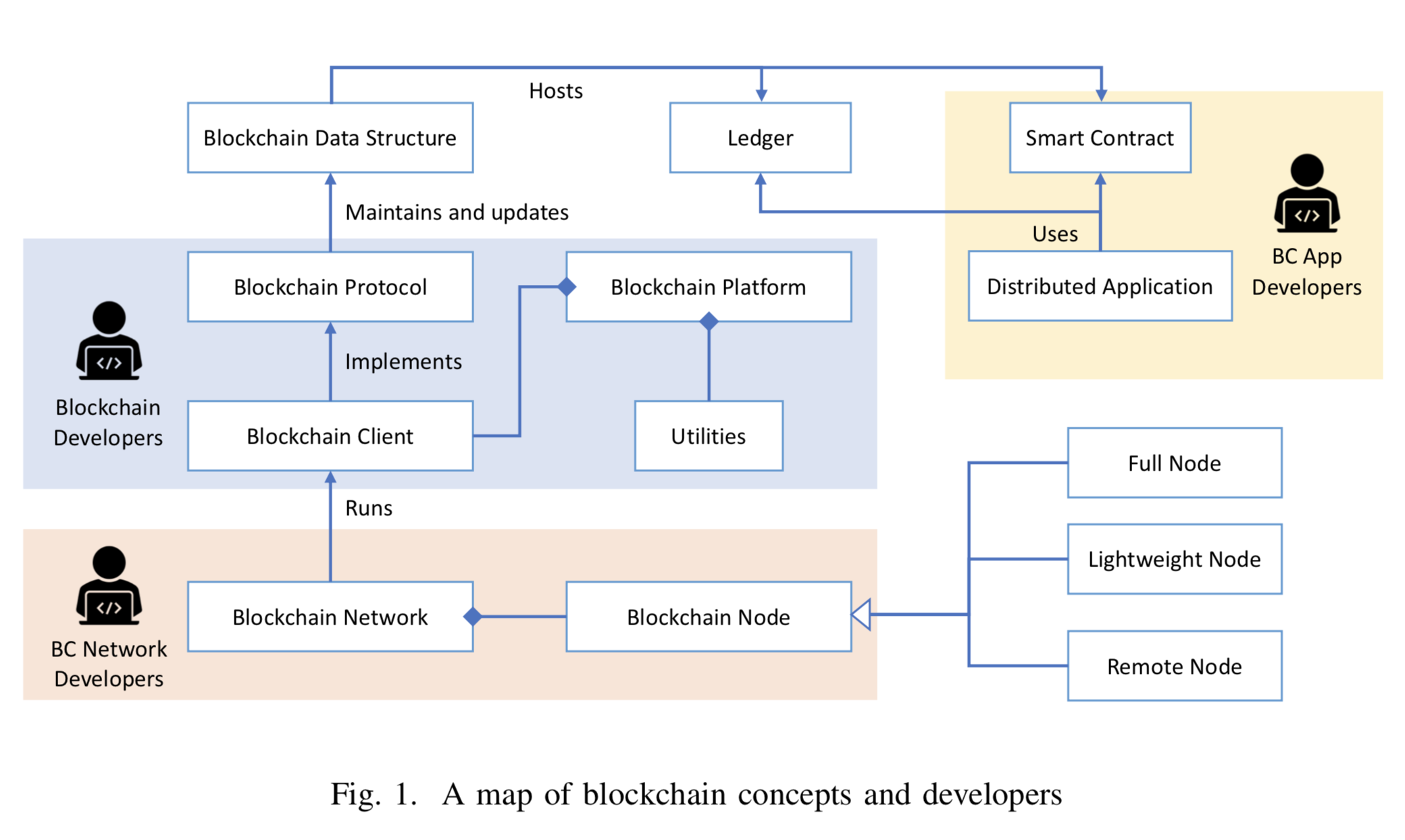
Map of blockchain concepts and developers
This map comes from my paper in ICSA2020 2.
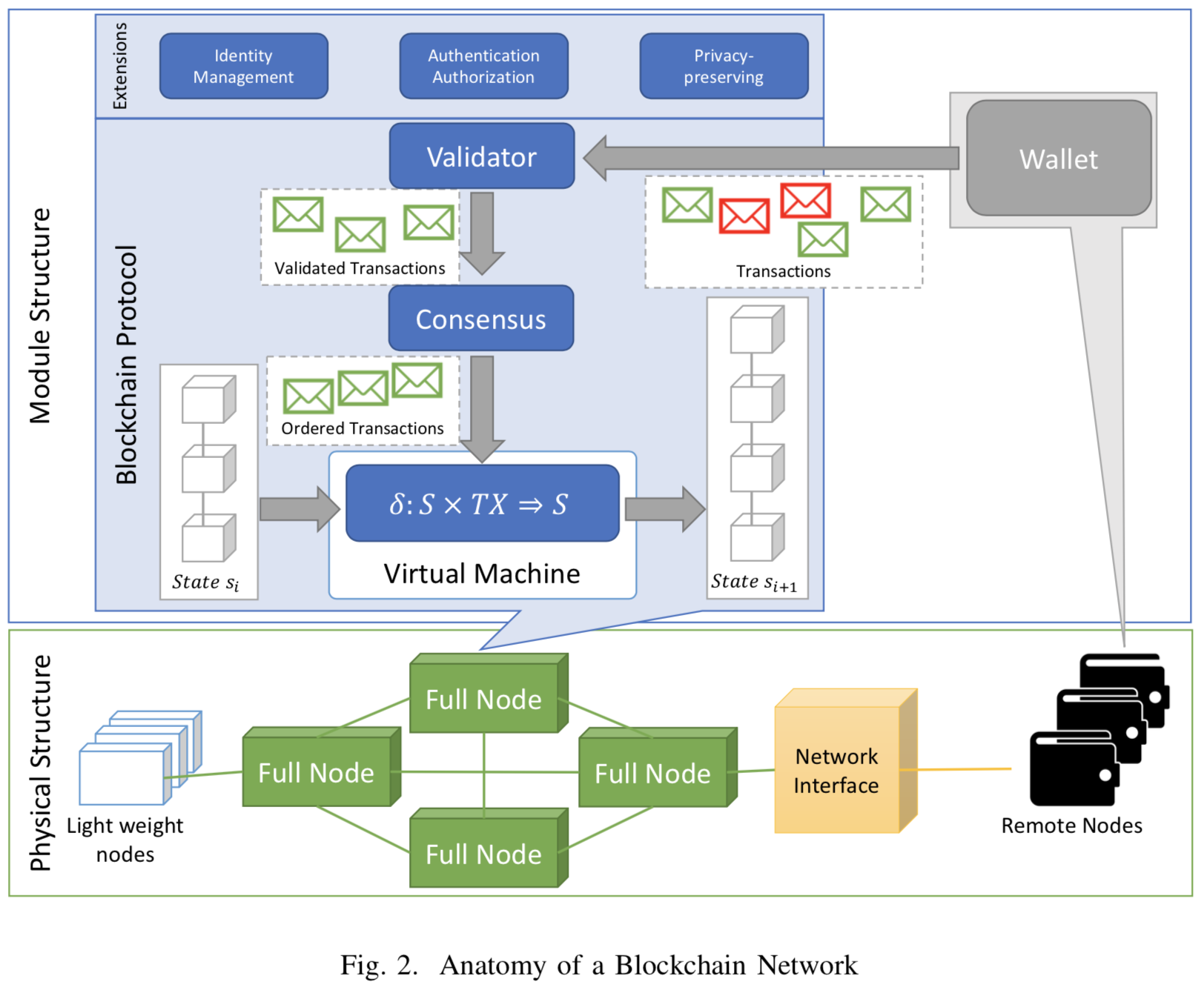
Anatomy of a Blockchain Network
This figure comes from my paper in ICSA 2020 2.
Elements of Blockchain Success
"The successful operation of a blockchain system relies on several key elements, including:"1
- Appropriate integrity criteria to be checked for each transaction and block
- The correctness of the system's software and technical protocols
- Strong cryptographic mechanisms to identify parties and check their authority to add new transactions
- A suite of incentive mechanisms to motivate processing nodes to participate in the community and behave honestly, in their interests
- Architecture for Blockchain Applications↩
- Implementing a microservices system with blockchain smart contracts; 2019 IEEE International Workshop on Blockchain Oriented Software Engineering (IWBOSE)↩
- Blockchain-oriented software engineering: challenges and new directions, 2017 IEEE/ACM 39th International Conference on Software Engineering Companion (ICSE-C)↩
- Anatomy, Concept, and Design Space of Blockchain Networks↩